

Career Journeys: Aadithya Suresh
Published: 31 March 2026
Read more
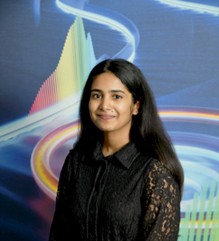
Aadithya Suresh, PhD student at Loughborough University
At the moment you are undertaking your PhD at Loughborough, what exactly is it that you are working on and what is a typical day like for you?
My PhD focuses on nonlinear photonics and microresonator frequency combs, which are compact optical devices that can generate many precisely spaced frequencies of light on a chip. These systems are promising for applications in areas such as precision measurement, sensing, and quantum technologies.
More specifically, I study laser cavity solitons and microcomb systems, looking at how these nonlinear states of light form, how stable they are, and how we can control them for practical applications. My work combines experiments, simulations, and data analysis.
A typical day can look quite different depending on what stage of the project I’m working on. Some days I’m in the lab setting up optical experiments or collecting data, while other days I’m writing code to analyse results, reading papers, or discussing ideas with my supervisors and colleagues. One of the things I enjoy about research is that there is always something new to learn or figure out.
Can you explain what led you to deciding to do a PhD in the field of quantum technology, and what attracted you to it?
I was always interested in science, and during my bachelor’s and master’s studies I explored several different areas of physics to understand what interested me the most. Toward the end of my master’s degree, I realised that I wanted to work in a field where I could combine deep fundamental science with the potential for real-world impact.
Quantum technologies and photonics bring these aspects together very naturally. What attracted me most was the idea that research in this field can contribute to technologies that improve precision measurement, communications, and sensing. I was also particularly interested in nonlinear optics, where complex behaviours of light emerge from relatively simple systems. The opportunity to explore these phenomena while contributing to future technologies made pursuing a PhD in this area a very exciting path for me.
Can you tell me a bit more about your experience of applying for your studentship?
Applying for a PhD studentship involved researching groups whose work aligned with my interests and preparing an application that highlighted my academic background and motivation for research.
The process usually includes submitting academic transcripts, references, and a statement explaining why you are interested in the project. After that there is typically an interview with potential supervisors where you discuss your background, the project, and your research interests.
Although the process can feel competitive, it is also a good opportunity to learn more about different research areas and groups. My advice for students would be to take time to explore different topics and apply to projects that genuinely interest them.
Can you tell us a bit more about the career paths you are considering?
At the moment I am interested in continuing in research and development related to photonics and quantum technologies. These fields are developing very rapidly and have applications across both academia and industry.
An academic career is one possibility, where I could continue researching and teaching, but I am also very interested in industry roles where photonic and quantum technologies are being developed into practical systems. One of the exciting things about this field is that there are many different directions you can take.
What do you feel is the highlight of your career to date and why?
One of the highlights of my career so far has been uncovering how bistability and hysteresis emerge in laser cavity soliton systems, showing how these nonlinear dynamics can give rise to effects such as optical memory in microresonator-filtered fibre lasers.
In a separate line of work, we also developed a physics-guided approach to experimentally discriminate soliton states using simple experimental observables. This provides a practical and cost-effective way to identify soliton states within the complex microcomb parameter landscape and moves towards more automated identification of these states in experiments.
I’ve had the chance to present this work at several international conferences and events. For example, I presented at CLEO/Europe–EQEC 2025, where I received the EPS-QEOD Young Minds Travel Grant Award, and also at the National Physical Laboratory during the International Year of Quantum event “Quantum Metrology: From Foundations to the Future”, which I attended through the Quantum Hub.
Can you give details of why you enjoy being part of the QEPNT Hub?
One of the things I really enjoy about being part of the QEPNT Hub is the strong sense of community it creates across different research groups working in quantum technologies. In many ways, it feels like being part of a wider research family where people are open to sharing ideas and supporting each other.
For PhD students especially, this kind of network is very valuable. Through the Hub I’ve had the opportunity to attend scientific meetings and interact with researchers from academia, national laboratories, and industry, which helps us understand different approaches to quantum technologies and build connections beyond our own research groups.
I particularly enjoyed attending the QEPNT scientific meeting where different groups presented updates on their research. It was interesting to see the variety of work being done across the Hub. At one of these meetings I also had the opportunity to give a short flash talk about my poster, which was a really nice experience and a great confidence boost.
The Hub also creates opportunities for early-career researchers to present their work to the wider community. Through the Hub I had the chance to present my research at the National Physical Laboratory (NPL), where there was also a Q&A session that allowed me to discuss my work and express my ideas. It was a great opportunity to share my research and hear perspectives from experts in the field.
Overall, the Hub creates a welcoming and supportive environment where researchers and students can exchange ideas, collaborate, and work towards the common goal of advancing quantum technologies for the future.
First published: 31 March 2026