
Technologies
QEPNT brings academia and industry together to develop quantum technologies which will be key for national security, critical national infrastructure and sectors such as aerospace, transport, energy, finance, communications and agriculture. We combine world-class systems engineers and scientists to co-develop quantum and hybrid PNT systems with our industry partners.
Timing
Professor Paul Griffin, University of Strathclyde and Professor Alessia Paquazi, Loughborough University, discuss the Hub’s progress in driving the next generation of portable atomic clocks using nanotechnology and mircocombs.
Inertial Sensors
Dr Joe Cotter, Imperial College London and Dr Carrie Weidner, University of Bristol, give an overview of the development of quantum-enhanced inertial sensors that can be deployed in rail and maritime environments, with a view to developing future long-range quantum navigation systems that can operate in satellite denied environments.
Ranging
Dr Istvan Gyongy, University of Edinburgh and Professor Louise Hirst, University of Cambridge discuss using single-photon avalanche diodes (SPADs) for use in LiDAR applications which have significant benefits especially for imaging through obscurants such as rain, fog, and dust. LIDAR is a key enabling technology for the emerging autonomous vehicle industry.
Hybrid Systems
Professor Jonathan Leach, Heriot-Watt University and Dr Alex Clark, University of Bristol, discuss the Hub’s ambitions to build hybrid demonstrators for land, air and sea applications, in digital and physical systems.
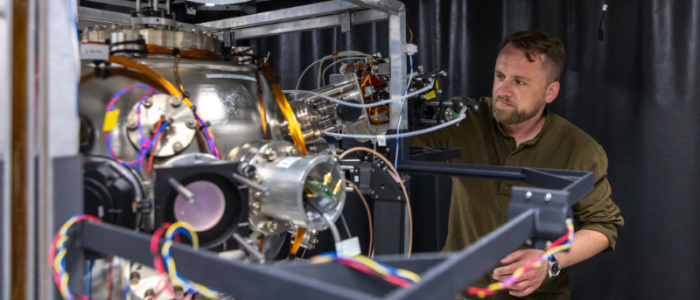
Low-drift quantum enhanced sensors for navigation
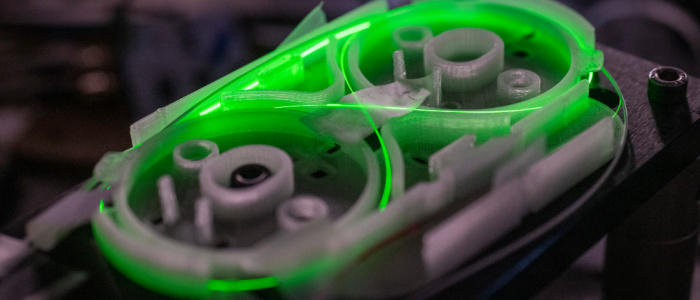
Optical Atomic Clocks: A Quantum Leap in Precision Timing
Driving the next generation of portable atomic clock using nanotechnology and microcombs