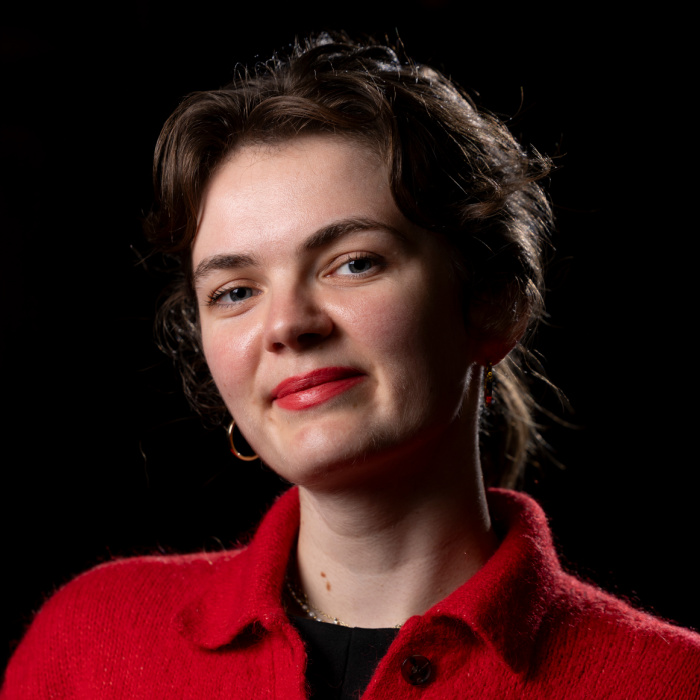
Introducing Cleo O'Callaghan Yeoman
Tell us about yourself
I currently work as a Research Associate at the Centre for Robert Burns Studies (CRBS) where I co-lead the project 'The Burns Supper at 225 Years: Scottish Tradition, Global Reinvention'. Prior to this, I spent the best part of four years busily completing my AHRC-funded PhD in English Studies at the University of Stirling (with co-supervision from the Universities of Glasgow and Edinburgh). I was awarded my PhD in October 2025, so this is my first academic role as a fully-fledged postdoc, and I feel very lucky to be in it.
Having only recently finished the PhD, it’s refreshing to work on an entirely new project and to be formulating new ideas. My PhD was all about the insalubrious reputation of the novel during the late eighteenth and early nineteenth centuries, and specifically about the role of three Scottish women writers (Mary Brunton, Susan Ferrier, and Elizabeth Hamilton) in helping to reframe the novel as a tool for intellectual and moral self-improvement. All but one of their novels appeared after Burns’ death, so they didn’t overlap directly – although Burns did write an admiring poem addressed to Ferrier’s elder sister, and so they were certainly aware of each other. Aspects of his legacy live on in their works in different ways – namely through their representations of Scotland and references to Burns’ poems, including ‘Highland Mary’ (not Ferrier’s sister). It’s exciting therefore to be working now on a different aspect of Scottish Romanticism (roughly the period spanning 1780 to 1830) and to be thinking about Scotland’s literary and cultural legacies from a different perspective.
How would you describe your research interests and current work to someone who is completely new to the subject area?
My work is all about the Burns Supper and understanding how it is celebrated across the world today. The year 2026 marks 225 years since the first ever Burns Supper took place on 21 July 1801 at Burns Cottage in Alloway, on the fifth anniversary of his death. What began as a relatively small celebration of a local man has since evolved into a global phenomenon (and, for many, a good excuse for a big party), uniting at least 9.5 million people each year. In recognition of this, 'The Burns Supper at 225 Years: Scottish Tradition, Global Reinvention' project aims to analyse the ways in which the tradition of the Burns Supper is maintained, but also adapted and reimagined, by different cultures and communities worldwide.
To this end, we’ve designed a global survey, in which we’re inviting anyone attending or hosting (or both) a Burns Supper in 2026 to tell us all about how they’re celebrating - what they’re eating, drinking, wearing, singing, reading, reciting, and so on. We’re also inviting people to send us photos and videos of their celebrations, which, along with their survey responses, will be plotted onto a big digital map of Burns Suppers to be launched later in 2026.
The other aim of the project is to recognise the Burns Supper as an example of what UNESCO calls ‘living heritage’, and which includes, among other things, social and culinary practices, sports, crafts, music, and dance. Any example of heritage, in other words, that cannot be stored in a museum (hence why it is also sometimes referred to as ‘intangible cultural heritage’), and that must therefore be preserved via other means, such as the digital archive that our crowdsourced dataset will create.
One of the things I enjoy most about my current work is that it challenges the stereotype of the literary scholar reading books all day – of course we do lots of that, but we build spreadsheets and analyse numbers too.
What would you most like people to know about you?
That I’m keen to do more cross-discipline and cross-sector work. I enjoy projects where there is something at stake for more than one group of people. Lots of us have an opinion on whether we think reading novels is good for us (and why), and that enabled me to have formative discussions with researchers working across many different fields (and also beyond the academy) during my PhD. At the CRBS, my work on the Burns Supper as Living Heritage facilitates and requires discussions with colleagues working across many different types of institution. I find this aspect of my job particularly rewarding and I’m keen to do more of it in the future.
What do you like most about working in the ARC?
It’s been said before on this series, but definitely its transparency. There’s a real hum of activity that runs throughout the building and that comes, I think, from people working in close proximity to one another across diverse disciplines. I really enjoy that aspect of working in the ARC, and it’s also effective in fostering a sense of community; because so many of us are working on different things, I think we make more of an effort to ask about (and then listen to) what other people are working on.